

This week, the Treasury Department issued final rules for the new Education Freedom Tax Credits (EFTC), a program that will allow taxpayers to direct money they previously would have paid in federal income tax to scholarships for students instead.
This could be game-changing for our schools and other Catholic schools serving low-income students across the U.S. The regulations released this week have us even more excited about the possibilities. But we are clear-eyed about some challenges they pose, and that’s where we look to Spiderman—and Catholic social teaching—for guidance.
What are tax credit scholarships?
As a dollar-for-dollar tax credit, the EFTC allows taxpayers to direct money to scholarships for the schools we serve—and it won’t cost them a dime in the end.
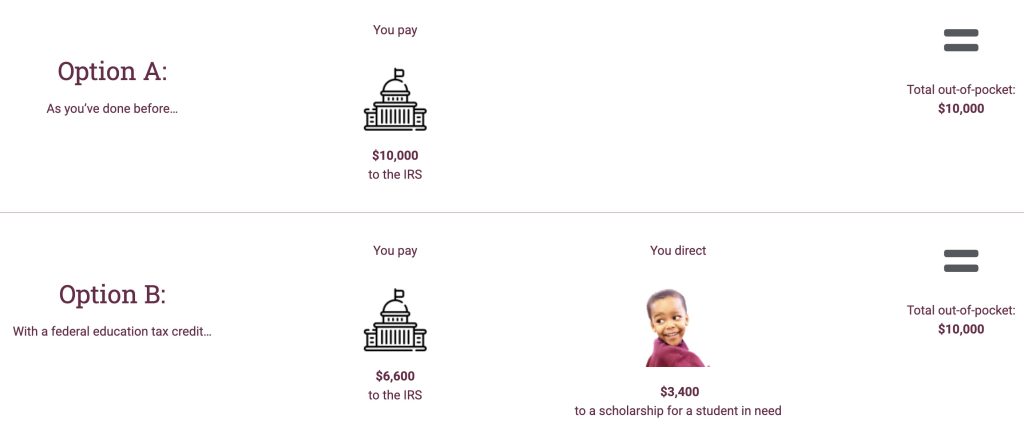
A couple with a $10,000 federal tax liability, for example, can direct up to $3,400 to a scholarship and pay the rest—$6,600—to the IRS. Over the last three years, the average philanthropic support needed for each of our students has been $3,500; now, a couple directing their tax credit scholarship to one of our schools could almost completely cover that gap without altering their bank balance.
Here’s what that could look like:
Ohioans might know that the program is similar to the tax credit scholarships of up to $750 for an individual ($1,500 for a couple) that the state has had for years. You can find out more about the federal program here.
How can taxpayers participate?
It will take time for scholarship granting organizations to get contribution portals set up, but you don’t need to wait–or even follow the news. We urge you to pledge your tax credit scholarship support to students in our schools now, even before the 2027 tax filing season begins. You can do that here. Then we’ll send you everything you need to know to claim the credit when the time comes.
What new information did this week's Treasury regulations reveal?
The legislation authorizing the federal tax credit scholarships—the Educational Choice for Children Act (ECCA)—passed this summer, but the draft regulations the Treasury Department issued today provide clarity on several key points that are particularly relevant for communities:
- Couples can claim up to $3,400. The legislation made it clear that individuals could claim up to $1,700; it’s now clear that couples can direct double that amount to scholarships.
- Taxpayers can max out both state and federal tax credits. This was uncertain in the legislation, and it’s particularly relevant for Ohio taxpayers.
- Scholarship Granting Organizations can serve multiple states. We knew that taxpayers from other states—particularly the 20 states that either have declined to participate or haven’t yet opted in—can direct their federal tax credit scholarship contributions to schools like ours. Multi-state SGOs might make this easier.
- Families won’t face undue burdens proving their income to qualify. This makes the application process less onerous, particularly for low-income families.
- While not a new rule, Treasury officials affirmed that $1,700 is NOT the scholarship amount. Scholarship Granting Organizations (SGOs) who process the tax credit scholarships can determine their own guidelines for how much scholarships are and which students are prioritized.
What do Spiderman and Catholic Social Teaching have to do with tax credit scholarships?
This Federal tax credit moves the power to direct public funds from the government to individual taxpayers and SGOs. And as we should all recall from Spider-Man, “with great power comes great responsibility.”
Those who seek to exercise the power of tax credit scholarships responsibly have two specific concerns to attend to.
Exacerbating educational inequality
Tax credit scholarships are like a well: in order for schools to draw scholarship funds out, taxpayers have to put scholarship dollars to them. What we’ve seen in Ohio should be no surprise: because wealthier communities have more taxpayers who can afford to fund a tax credit scholarship and wait to be reimbursed with their tax refund, they are more likely to contribute–and they tend to direct their contributions to schools in their communities, which often serve fewer low-income students.
If taxpayers and SGOs prioritize low-income students, then this program can ameliorate educational injustice. But taxpayers and SGOs must consciously aim scholarship funds at those most in need for tax credit scholarships to contribute to, rather than undermine, economic and educational justice.
Using EFTC to justify cuts in other educational funding
As the Brookings Institution notes, the expansion of tax credit scholarships is coming at the same time as proposed cuts to federal programs like Title I, which provides tutoring for students in academic need in low-income communities—including those in Catholic schools. If programs specifically aimed at low-income students are cut at the same time that tax credit scholarship contributions concentrate in higher-income communities, then the educationally rich will get richer at a time when our country needs every child—including those in low-income communities—to thrive.
*This post has been updated to reflect that 2027 is the first tax year for which the credit applies.
