
We ask students to grow every day, and the best teachers are practicing what they preach. They ask themselves hard questions about how their students learn and continually try new ways to help every child succeed. Supporting that evolution is the heart of what our network does.
Evolving our approach matters especially at Partnership Schools. Our students are made in the image and likeness of God, so making the most of their God-given gifts is imperative. We also welcome many students with learning gaps, so our classrooms have to drive learning at a faster rate than national averages for students to catch up and excel.
This year, we’ve made three key changes to help teachers and students accelerate learning. We created the Director of Curriculum and Instruction (DCI) role—a teaching expert at each school who joins the principal in coaching teachers. We added IXL, an AI-informed learning platform, to teachers’ toolboxes. And together, DCIs and teachers are using data far more frequently to adapt in real time to students’ needs.
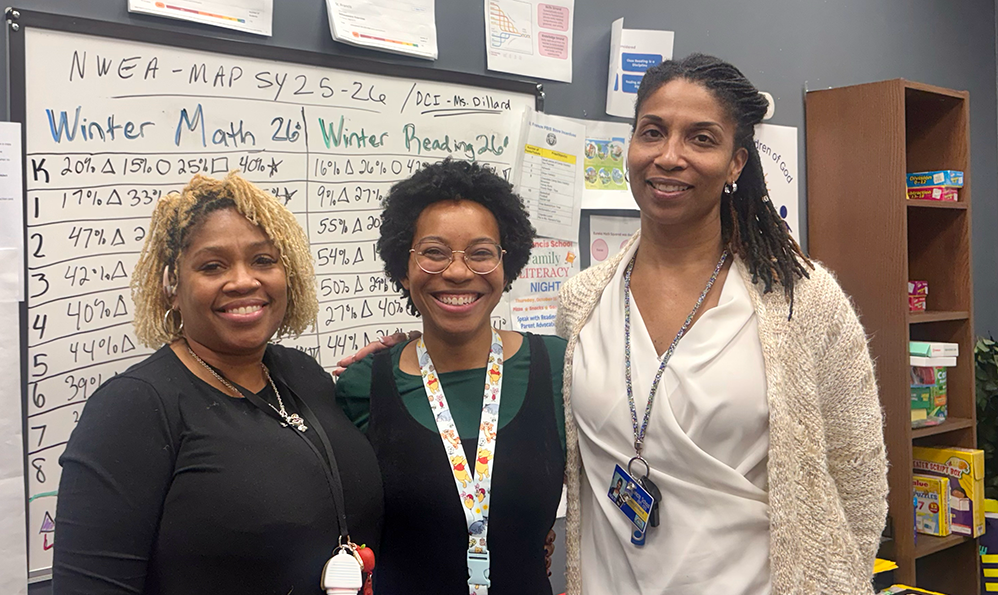
How is the work to implement these shifts going? We’re learning from our school leadership teams and from teachers, including three spotlighted here.
Erin Dziak, St. Thomas Aquinas, 6–8th Grade ELA
Six years of deliberate routine-building—packets waiting when students walk in, dots on the floor to keep desks and brains orderly—have freed Erin’s attention for what matters most: getting students ready for high school, AP, and IB coursework.
This year, ongoing coaching cycles have helped Erin shift her core question from “do they know what’s in this book?” to “can they take this skill and apply it somewhere else?” IXL is helping her answer it. She assigns a single targeted skill each Friday — not from the pacing guide, but based on what she’s watching students struggle with in real time. One student might master it in 20 questions. Another needs 80. IXL makes that personalization possible. Erin’s candid that one way the network team suggested teachers use the program isn’t so useful yet: having kids get computers out at the end of a literature lesson to test on IXL. But she’s embracing the program and its skill emphasis in other ways.
The payoff or Erin’s evolving craft shows up in her classroom’s deeper moments: a seventh grader who caught an inference mid-read in A Raisin in the Sun and stopped himself to share his hunch, or eighth graders wrestling with Frederick Douglass’s arguments about faith and justice. Students who’ve been with Erin since sixth grade now have the stamina for ninety minutes of rigorous reading, writing, and thinking. And she’s fine-tuning how she teaches writing to foster independence. “I need to make sure you are ready to fly without me.”
Tiombe Morrow-Cheeks, St. Francis, Middle School Math
Tiombe’s students come with complexity — ADHD diagnoses, IEPs, a lot of energy, and significant gaps. To serve them, she worked with her new DCI, Vassimo Dillard, to adapt the curriculum, supplement it with IXL, and use the daily intervention block in new ways.
IXL’s built-in videos have been especially valuable for students with recall challenges — a resource they can return to independently. Lightning rounds and leaderboard competitions keep energy high during the morning warm-up. Exit tickets on IXL show Tiombe in real time who got it and who didn’t.
IXL and MAP data are also reaching beyond the classroom. Family goal-setting conversations help parents understand how their child is progressing nationally, and IXL gives them a way to stay involved at home. The how-to videos remove the “new math” barrier many parents face. “Parents can’t give what they don’t have,” Tiombe says — but now there’s a video.
Vassimo is a veteran educator, and her role goes beyond coaching. She co-teaches during intervention, takes small groups so Tiombe can work at multiple levels simultaneously, and brings an experienced perspective to tough parent conversations.
Kayla Stevens, St. Francis, 1st Grade Reading
In just her second year, Kayla is moving fast. She launched fluency routines in September — work she hadn’t reached until January her first year — and is now running four data-driven small groups where she had three before.
Rather than assigning IXL by curriculum sequence, Kayla curates skills directly from each student’s NWEA scores, making the experience more positive and reducing behavior issues. She’s also using IXL to address a writing gap her core curriculum leaves open, and sending it home so families have a tool they can actually use. Vassimo’s coaching adds a second set of eyes in the classroom and a steadying presence in parent conversations.
Three classrooms, three grade levels, three different challenges. The same throughline: teachers who know their students deeply, use data to act on what they see, and have the support to keep getting sharper. That’s what learning — for teachers and students alike — looks like this year.
