Federal Tax Credit Scholarships: A Game-Changer, if We Listen to Spider-Man

This week, the Treasury Department issued final rules for the new Education Freedom Tax Credits (EFTC), a program that will allow taxpayers to direct money they previously would have paid in federal income tax to scholarships for students instead.

This could be game-changing for our schools and other Catholic schools serving low-income students across the U.S. The regulations released this week have us even more excited about the possibilities. But we are clear-eyed about some challenges they pose, and that’s where we look to Spiderman—and Catholic social teaching—for guidance. 

What are tax credit scholarships?

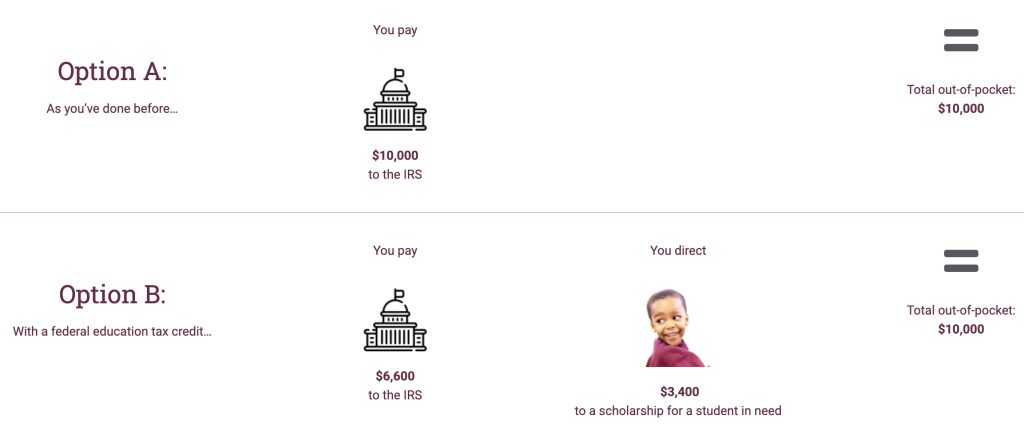
As a dollar-for-dollar tax credit, the EFTC allows taxpayers to direct money to scholarships for the schools we serve—and it won’t cost them a dime in the end. 

A couple with a $10,000 federal tax liability, for example, can direct up to $3,400 to a scholarship and pay the rest—$6,600—to the IRS. Over the last three years, the average philanthropic support needed for each of our students has been $3,500; now, a couple directing their tax credit scholarship to one of our schools could almost completely cover that gap without altering their bank balance.

Here’s what that could look like:
Ohioans might know that the program is similar to the tax credit scholarships of up to $750 for an individual ($1,500 for a couple) that the state has had for years. You can find out more about the federal program here. 

How can taxpayers participate?

It will take time for scholarship granting organizations to get contribution portals set up, but you don’t need to wait–or even follow the news. We urge you to pledge your tax credit scholarship support to students in our schools now, even before the 2027 tax filing season begins. You can do that here. Then we’ll send you everything you need to know to claim the credit when the time comes.

What new information did this week's Treasury regulations reveal?

The legislation authorizing the federal tax credit scholarships—the Educational Choice for Children Act (ECCA)—passed this summer, but the draft regulations the Treasury Department issued today provide clarity on several key points that are particularly relevant for communities:

  • Couples can claim up to $3,400. The legislation made it clear that individuals could claim up to $1,700; it’s now clear that couples can direct double that amount to scholarships.
  • Taxpayers can max out both state and federal tax credits. This was uncertain in the legislation, and it’s particularly relevant for Ohio taxpayers.
  • Scholarship Granting Organizations can serve multiple states. We knew that taxpayers from other states—particularly the 20 states that either have declined to participate or haven’t yet opted in—can direct their federal tax credit scholarship contributions to schools like ours. Multi-state SGOs might make this easier.
  • Families won’t face undue burdens proving their income to qualify. This makes the application process less onerous, particularly for low-income families.
  • While not a new rule, Treasury officials affirmed that $1,700 is NOT the scholarship amount. Scholarship Granting Organizations (SGOs) who process the tax credit scholarships can determine their own guidelines for how much scholarships are and which students are prioritized.

What do Spiderman and Catholic Social Teaching have to do with tax credit scholarships?

This Federal tax credit moves the power to direct public funds from the government to individual taxpayers and SGOs. And as we should all recall from Spider-Man, “with great power comes great responsibility.”

Those who seek to exercise the power of tax credit scholarships responsibly have two specific concerns to attend to.

Exacerbating educational inequality

Tax credit scholarships are like a well: in order for schools to draw scholarship funds out, taxpayers have to put scholarship dollars to them. What we’ve seen in Ohio should be no surprise: because wealthier communities have more taxpayers who can afford to fund a tax credit scholarship and wait to be reimbursed with their tax refund, they are more likely to contribute–and they tend to direct their contributions to schools in their communities, which often serve fewer low-income students. 

If taxpayers and SGOs prioritize low-income students, then this program can ameliorate educational injustice. But taxpayers and SGOs must consciously aim scholarship funds at those most in need for tax credit scholarships to contribute to, rather than undermine, economic and educational justice.

Using EFTC to justify cuts in other educational funding

As the Brookings Institution notes, the expansion of tax credit scholarships is coming at the same time as proposed cuts to federal programs like Title I, which provides tutoring for students in academic need in low-income communities—including those in Catholic schools. If programs specifically aimed at low-income students are cut at the same time that tax credit scholarship contributions concentrate in higher-income communities, then the educationally rich will get richer at a time when our country needs every child—including those in low-income communities—to thrive.

*This post has been updated to reflect that 2027 is the first tax year for which the credit applies.

A Path to Progress Amid the National School Attendance Crisis

Last week, a student at St. Francis School in Cleveland threw a pie in the face of Principal Molly Hanna. The student was not defying authority; instead, she was defying a national trend. With perfect attendance for the month, the student, her parents, and the administration at St. Francis are making progress rebuilding attendance habits weakened across the U.S. during the pandemic. 

Last year, around one out of four American school children was chronically absent from school; in Cleveland’s public schools, just over half of students were chronically absent–missing ten percent or more of school days. According to research shared by the State of Ohio, students who are chronically absent are 65 percent less likely to read on grade level by third grade and a whopping 89 percent less likely to graduate on time. 

Partnership Schools’ chronic absenteeism was a bit better than the city’s public schools last year. Yet we knew with certainty that if we want our students’ academic achievement to improve, we must make progress on having them with us every day. So from Day 1 this year, our schools began an all-out push to improve daily attendance–an effort that hasn’t let up, even months later. That work is producing heartening results.

By mid-November, the percentage of students chronically absent dropped by a quarter compared with the prior year. We have routinely seen days when schools and families hit our target of at least 95% students present. 

Daily attendance remains a daily effort, and we are aiming for far better attendance. Yet we are heartened not just by the progress our schools are making so far, but also by the way they are making it—using approaches propelled by some of the unique tools a Catholic school network can bring to bear. Four factors are, we believe, instrumental to the progress:

  • Network/school collaboration: The network set ambitious, customized goals for each school’s attendance before the school year began, and then the school support team has worked with each school leadership team to find the most effective levers for improving results. From the beginning, the network-school collaboration has been anchored in research we analyzed together—including a finding that if a student misses two-five days in September, they are five times more likely to be chronically absent that year. 
  • Effective use of data: The network team is also supporting the schools with actionable data gathering and collaborative analysis. Together, the network-wide operations team helps schools monitor progress while also drilling into the data to identify families whose struggles with attendance may be flying under the radar. For example, every Friday, the network team and school leaders take a look together at a quick snapshot like the one above. The shared data helps prompt collaboration between the network team and school leaders—and among school leaders—on next steps for further progress or problem identification when new trends appear.
  • Clear, frequent, and urgent communication: Rachael Dengler shared that during the welcome-back activities for St. Thomas families in August, she and Dean Tali Collins talked with every family individually, sharing a copy of the attendance policy and the reasons why daily attendance is so important, discussing each family’s hurdles and plans, and then having each family sign a copy of the policy. The administration communicates weekly with families about how the whole community is progressing toward shared goals, and they follow up individually with families to work on problem-solving. All four schools have adopted similar strategies—and are seeing progress as a result.
  • Powerful relationship-building: By far the most important tool for improving attendance is proving to be relationships. As Principal Manager Nick Green explains, “In the past, following up with families when students are out was just a formality. We were just going through the motions.” Rachael Dengler shares one way that looks in practice: “no more robocalls.”  

Nick elaborates: “Now, our school teams are making calls with care and curiosity, making sure families know just how badly we want to see their children’s smiling faces in our building each day. Our leaders are meeting with families regularly and with urgency to intervene and prevent any further missed learning opportunities. They are sending the message that we love their kids and we all need them to be present and learning.”

Students holding monthly perfect attendance certificates
Just some of the Archbishop Lyke students with perfect attendance in October.

St. Francis principal Molly Hanna echoes the importance of relationships when it comes to finding the incentives that inspire students to keep up attendance. “We provided a McDonald’s lunch to students with perfect attendance for the month, and that wasn’t nearly as effective as other activities like the pie throwing or other activities that students get to do together. So we are adapting our rewards as a result. Our next one will be a surprise dance party. It’s free, and it gives students what they want the most: fun time together.”

It can be alarmingly easy to slip into chronic absenteeism; just two or more days absent a month put a student at risk of falling behind. The biggest challenges to regular attendance? “Transportation,” Rachael says without hesitation, adding that “we continue to see too that when one student is sick, a parent keeps all the children home—in some cases, so that older children can help with younger siblings who are sick.” 

Since the Partnership began, the three pillars of focus, excellence, and support have guided our work. In the case of attendance, all three pillars are essential. A relentless, network-wide focus on making ambitious progress, along with meaningful support from the network team for work that is best done by school personnel with the closest relationships with families—are helping us tackle attendance challenges that are as varied as the families we serve.

*Data in this post have been updated.

The Partnership’s Work in New York Concludes

Last week, the Archdiocese of New York let us know that they will resume direct management of the seven schools the Partnership has been managing in New York at the expiration of our 11-year services agreement with the Archdiocese. Thus Partnership Schools’ work in New York will conclude June 30, 2024, even as our work in Cleveland continues full steam ahead.

Next Steps for the Seven New York Schools

In a message to families of the schools this week, Partnership Superintendent Kathleen Porter-Magee shared:

In terms of what this means for you and your children in the next year, we anticipate few day-to-day changes. For example, the tuition you are approved to pay for 2024-2025 will remain the same, and the school day will remain extended (ending at 4:00pm for most grades). In addition, the teachers and principals of your schools have always been Archdiocesan employees, so their 2024-2025 contracts will not be affected.

On behalf of the team at Partnership Schools, we have been honored to serve your children and your communities. We named our organization Partnership Schools, because we knew that our work was always meant to be a true partnership with the Archdiocese. Those of us at the network will take heart knowing that the strength of our work—and the engine that has fueled our results—lies in each of our communities. While the management structure of the schools may change, the strength of our school communities will not. And we look forward to continuing to watch your schools and children soar in the years ahead.

The schools that will experience this transition include:

Our Lady Queen of Angels, East Harlem                      Sacred Heart School, the Bronx

Mt. Carmel-Holy Rosary, East Harlem                          Immaculate Conception, the Bronx

St. Mark the Evangelist, Harlem                                        St. Athanasius, the Bronx

St. Charles Borromeo, Harlem                                                                         

Archdiocesan Superintendent Sr. Mary Grace Walsh, ASCJ, added, “On behalf of the Archdiocese, we look forward to closer collaboration with all seven schools in coming years.”

What’s Next for Partnership Schools

We will continue to run Cleveland’s four Partnership Schools—in fact, we are thrilled to double down on the work and explore expanding it to serve more Cleveland students and schools. 

Dr. Frank O’Linn, Superintendent of Schools for the Diocese of Cleveland and Partnership Trustee, shared with Executive Director Kristen Gengaro in an email this week that “Partnership Schools has been a valuable asset to the Diocese of Cleveland since the launch of our management agreement in 2020. The network’s impact has grown in this diocese, and we look forward to continuing our partnership to benefit the increasing number of students and families served by our Catholic schools in the heart of the city.” 

The Diocese of Cleveland’s current agreement with Partnership Schools to operate Metro Catholic, St. Francis, St. Thomas Aquinas, and Archbishop Lyke runs through 2028 and is renewable at that time. 

Additionally, we are eager to find the next city where we can leverage the power of Catholic schools in underserved communities, ambitious philanthropy, and educational expertise to transform outcomes for children and communities. The Partnership will begin that discernment process at the conclusion of the transition of our New York schools’ management back to the Archdiocese.  

Board Chair Russ Carson shared in a message with trustees this week, “Ending our management contract with the Archdiocese of New York is not the end of Partnership Schools, but rather the beginning of a journey to see if we can implement our programs on a more national basis.”

A Look Back at a Groundbreaking Eleven Years

Partnership Schools began in 2013 when an ambitious group of donors to New York’s Catholic schools, committed educators, and the Archdiocese worked out an agreement to launch a bold experiment: to stand up an organization that would take on management of schools while they remained owned by the diocese, with an eye toward turning around struggling Catholic elementary schools in underserved communities. 

That experiment’s success is reflected in many ways: thousands of children who have achieved deep, enduring learning gains and millions of dollars in scholarship support to attend top-tier high schools; a 28% enrollment increase since the start of the pandemic; and a model that is poised to make similar gains in Cleveland. 

NYC Partnership Class of 2024 High School Destinations

The Partnership Class of 2024 earned $7.7 million in scholarships and aid to attend high school—up from $3.3 million just two years ago. The percentage of students attending top-tier Catholic, independent, boarding, selective public, and high-performing charter high schools remains on par with last year—85% of students in our New York Schools.

“We facilitate high school agency in a way that parents have the opportunity knowledge to support their child in securing a fit flourish High School Placement” explains Chris Matesic. 

Students have been accepted to:

Academy of Mt. St. Ursula

All Hallows High School

Archbishop Stepinac

Art and Design HS

Avon Old Farms School

Bard High School Early College

Birch Wathen Lenox School

Cardinal Hayes High School

Cardinal Spellman High School

Cathedral High School

Celia Cruz High School

Columbia Secondary School

Convent of the Sacred Heart

Cristo Rey High School

Dwight School

Episcopal High School

Fordham Preparatory School

La Salle Academy

Leadership and Public Service High School

Masters School

Miss Halls School

Monsignor McClancy High School

Monsignor Scanlan High School

Mount Saint Michael Academy

New Visions Charter HS for the Humanities I

New Visions Charter HS: Advanced Math and Science

Notre Dame High School

Preston High School

Regis High School

Salesian High School

St. Barnabas High School

St. Catharine Academy

St. Jean Baptiste High School

Talent Unlimited

University Prep Charter High School

Urban Assembly Gateway School for Technology

Urban Assembly Maker Academy

Xavier High School

Young Women’s Leadership School of Manhattan

Jill Kafka Announces Retirement

After 26 years of transformational leadership on behalf of children and Catholic schools, Jill Kafka has announced that she will step down as the Executive Director of Partnership Schools at the end of 2023.

Jill began volunteering in 1997 for a small “adopt a school” program for Catholic elementary schools in the Archdiocese of New York, little realizing that it would be the start of a new career. In 2011, she led the transformation of two fundraising programs, the Patrons Program and the Endowment for Inner-City Education, into Partnership Schools.

Since the network began with Jill at the helm, the number of students Partnership Schools serves has grown from a low of 1,969 to almost 3,600 today. As Jill noted in a message to Partnership community members, “What started as an experiment in independent Catholic school management, with six schools in the South Bronx and Harlem, is now a nationally recognized model with eleven schools in NYC and Cleveland and a proven approach to urban Catholic school turnaround.”

She also shared:

Our students are now graduating and being recruited by top Catholic, private, public and boarding high schools, earning record amounts of scholarship and financial aid. Our enrollment is up 28% in the last three years and demand remains high. Covid showed us what we already knew—that Catholic schools can weather the greatest storms because they have foundational strength and enormous value serving low-income students in urban areas. And Partnership Schools tapped that value and showed this country why Catholic schools are worth saving.

I’m particularly proud of what we have accomplished together. Under my leadership over the last thirteen years, our wonderful donors have contributed $127 million to support our eleven schools. That combined with the $100 million that was raised at the Patrons Program means I’ve been part of an unprecedented investment to further the work of Catholic education. What a privilege it has been. You all have supported me in countless ways and are an amazing group of generous and deeply caring people who have made this progress possible. Our success is a direct result of those who believed in us and took a chance on my leadership and our groundbreaking idea to try a new approach to supporting and managing Catholic schools…

…Over the next three months I will be working with the team, with the Board, and with our supporters to ensure a smooth transition. I leave the Partnership knowing that our collective efforts have impacted thousands of lives and provided countless opportunities and bright futures for underserved students. I couldn’t be more optimistic about the future of Catholic education and more heartened by the momentum at Partnership Schools.

My gratitude is immense. I have had the privilege of leading a team of bold, smart, talented, and passionate individuals. They have taught me so much. The teams at our schools have my deepest appreciation for doing the slow, steady, and difficult work every day. They are my heroes.

Partnership Board Chair Russ Carson also shared a message with the Partnership community, noting:

I met Jill years ago when my wife and I became interested in the Patrons Program and have had a wonderful working relationship with her ever since. When we formed Partnership Schools in 2013, she was the logical person to be CEO of the new organization. She has poured her heart and soul into this effort and the results speak for themselves.

From a standing start, Partnership Schools has grown from six schools in New York City to seven in NYC and four in Cleveland. In NYC we went from less than 20% of our students performing at or above grade level to over 50% doing so by 2019. Currently, 3,500 students in the two cities are getting a first-class education while being exposed to the values that will make them good citizens throughout their lives. None of this could have happened without Jill’s tireless efforts.

Russ also shared that last spring, Jill “brought on Kristen Gengaro as Deputy Director and a potential successor which has set the stage for a very smooth transition of leadership. Over the next three months Jill will transfer authority and leadership responsibility to Kristen. By the start of 2024 we will have put in place a solid plan and management team for the future.”

St. Charles Borromeo Nearly Doubles Its Enrollment

This week, St. Charles Borromeo School enrolled their 369th student. Just three years ago—as St. Charles joined the Partnership in 2019—they had 186 students. Principal Natalia Rodrigo and her team have nearly doubled the size of the school, and the student body has increased over forty percent since just last year.

How are they doing it? “It’s multifaceted,” Natalia explains. “But mostly, it’s community outreach. And when someone applies, we are intentional and personal about giving them a sense of what it’s like to be a St. Charles student.”

She elaborates: We’ve been very intentional about all our partnerships with community groups. The word has gotten out, particularly about how affordable we are. So interest is up, and we’re getting a lot of referrals.”

“Our root beliefs include the idea that we are a family, and every one of us on the team exhibits that from the moment anyone enters this building. We are finding that personal touch means so much. People don’t just want a school; they want a community. And they want a community that really knows them.”

St. Charles Dean Shameika Freeman holds a story time for newly admitted students, one way the school builds a sense of community with new families over the summer.

“For example, one mom called to inquire about her students coming here and kept saying, ‘but we’re Muslim.’ It wouldn’t work for me just to tell her over the phone that her children are welcome here. She came in, and she experienced first-hand the respect I told her about. She saw the materials from the Core Knowledge Language Arts unit where all our students learn about Medieval Islamic Empires. And the curriculum plays a role for other parents, too. Plus, the building looks great.”

The enrollment increase at St. Charles provides a powerful proofpoint about how the Partnership unlocks the opportunities that exist for Catholic schools in the neighborhoods we serve. In our first decade, we’ve come to appreciate how much our work demands a strategic balancing of both network support and school team ownership.

New and returning middle schoolers make candles in a community activity over the summer.

For example, St. Charles’s affordability is a direct result of the tuition pilot that the network rolled out across all seven New York schools last year. As a network, we clarified what our schools cost to parents, simplified the process of applying for the scholarships that fill the gap between what families can afford and what our schools cost, and set about fundraising for those scholarships on a scale that would be nearly impossible for a lone parochial school to accomplish. Additionally, our inquiry and enrollment systems—along with the curriculum that Natalia notes is now influencing parents’ decisions—are all network-wide.

Yet as Partnership Vice President of Operations Maria Cristina Ventresca explains, “the support our network gives when it comes to enrollment systems and scholarships is essential, but it is not enough. As increases at St. Charles and several of our other schools demonstrate, parents’ decisions about where they send their children to school are deeply personal. School teams can build personal relationships and conduct creative outreach in their communities better than our network team ever could. And while the network provides tools like our enrollment system and approach to tuition, it is only the way schools use those tools that can really impact the number of students we serve.”

Along with St. Charles, all our schools throughout New York and Cleveland will continue to enroll students as the school year kicks off, building on last year’s 15 percent enrollment increase in New York and the astounding forty percent increase that our first two Cleveland schools achieved in 2020. As Partnership Assistant Superintendent Christian Dallavis explains, increasing the number of students we serve isn’t the goal of our work; it is the start of it. “Growing enrollment is the first step. The long game is preparing future leaders…whose lives will make God known, loved, and served.”


The Partnership Names Four New Executive Principals

When the Partnership began to run Catholic schools in a new way a decade ago—leveraging the power of a network to unlock the full potential of schools with deep community roots—our aim was to ensure that each principal had the support s/he needed to lead effectively. Crucial to our model from the jump, however, was our steadfast belief that we cannot run great schools from the network office. The network team is a support structure; the schools are the engine. This month, we institutionalize that ethos in a new way: by naming four currently-serving school leaders to be the first Partnership executive principals.

Together, Abigail Akano, Jessica Aybar, Alexandra Benjamin, and Natalia Rodrigo represent 29 years of school leadership—and a range of invaluable perspectives. As executive principals, they will remain leaders of the four Partnership schools they serve—Sacred Heart, St. Athanasius, Immaculate Conception, and St. Charles Borromeo—while also providing strategic leadership network-wide.


Crucial Voices


“Our school leaders are critical network leaders,” Superintendent Kathleen Porter-Magee explains. “We aim to create a model that elevates voices from our schools and extends their impact without removing them from their communities.”

Jessica Aybar explains, “One of the Partnership’s core values is humility, and it’s a value that I’ve seen modeled by network leaders so many times. As principals, we’re invited and encouraged to share feedback, problem-solve challenges and poke helpful holes in plans to get to a more refined end product. I see the executive principal role as an opportunity to take that to the next level by being more involved in establishing the network vision for academics, operations, and culture.”


Jessica Aybar, Executive Principal of St. Athanasius School in the Bronx.


A Climate of Trust


There’s one word all four executive principals use when they talk about what it’s like to lead a school within the Partnership: trust. Alexandra Benjamin worked for a charter network before coming to the Partnership, and she explains, “The Partnership differs from other networks that I have worked for in that the network has allowed me to lead ICS in a way that is aligned with my vision. The trust and support they have provided me have allowed me to achieve many of the goals I have set for ICS. The ability to work within a team that welcomes authentic conversation and thought-partnership is something that makes me feel like my experience and beliefs are valued when doing this challenging work.”

Alexandra Benjamin, Executive Principal of Immaculate Conception in the South Bronx.


A Spirit of Collaboration

Abigail Akano is excited about this new role because it gives her more opportunities to help support new leaders in the network. Yet she’s quick to explain that such collaboration among principals has already been happening for years: “There is not a day that I don’t text and call colleagues, and I want new leaders to feel that way. I want to be able to learn from others and have them learn from me. Being a principal in the network is so much less silo’ed; there is a spirit of community.”

Abigail Akano, Executive Principal of Sacred Heart School in the Bronx.

Natalia Rodrigo concurs. “One of our SCB root beliefs is “We are a Family.” The Partnership embodies that.  A family seeks out what will make it stronger and will create a foundation for it.” And Alexandra is quick to agree: “We have always worked together to problem solve, share ideas, and laugh….ALOT.”

Natalia Rodrigo, Executive Principal of St. Charles Borromeo School, Harlem.


A Diversity of Perspectives


With typical candor and trust, several of the executive principals also note that their elevation to this new role is important for the diversity they add to the network leadership team. “During the George Floyd summer,” Abigail explains, “we had a network-wide conversation where we talked about diversity in the network. This is one step toward racial diversity in the network’s leadership team.”

Natalia agrees. “Representation matters. It is important that our students and community have educators that look like them, care, and hold them to a high standard.”

The diversity that our executive principals bring to network decision-making is multi-dimensional. Abigail also notes that “it’s one thing for network-level folks to make decisions, but they have a lens that is different than that of those of us who are in the trenches. Both views are important. Additionally, the four of us who are exec principals bring very distinct views.”


Conclusion


“Transformational schools need transformational leaders,” Jessica explains. Transformational networks do too—which is one of many reasons we are thrilled to have four transformational leaders as the Partnership’s new executive principals.

“I am so proud of them”: Students Ace Algebra Regents Exam

This summer, for the first time since the Partnership began, eighth graders in our New York schools took the Algebra 1 Regents Exam—and 67 young mathematicians passed the test, which means they earned high school credit for math they did in middle school. Getting them there was a three-year project that our curriculum team and fearless teachers persisted with, even as the pandemic caused widespread learning disruptions.

As a result, while the NWEA estimates that 2022 eighth-graders may need as much as five years to make up for the learning delays of the pandemic, Partnership students continued to make progress. And mastering Algebra 1 before high school means students can continue progressing—into higher-level math and science classes that are the gateway to STEM careers.

Algebra is the single most failed course in high school and community college and a leading cause of the high community college dropout rate. It is a gatekeeper for so many students—which makes our students’ mastery of it in eighth grade all the more impactful.

“They did it! We did it, together.”


Coral Elias, who has taught middle school math at Sacred Heart School for nine years, had the highest passing rate in our network. As Vice President of Academics Maggie Johnson explains, “Coral is a genuine master of her content. She knows precisely what her students need to take away at the end of the day and crafts each lesson with so much intentionality to get there. She makes it look effortless, but we know the systematic planning she does to map each lesson so every single student in her room is with her. To watch her persist with a struggling student, nimbly feeding the information they need to “get it” without taking away the challenge—and never doubting that they can answer the questions she’s chosen for them—is a thing of beauty.”

Here’s what Coral has to say about the students’ Algebra 1 Regents results:

I am so proud of them. They were so worried, but at the same time they were excited to take the exam. And look: They did it! We did it, together.

The eighth graders finished classes before everyone else weeks before the exam, but I created two Regents prep sessions every day, and they came, even when they weren’t required to.

I was telling one of the students who tried and did not pass, don’t worry; you’ll have a chance to take it again next year. So next year will be like a review, and students will have an opportunity to take the test again.

Middle schoolers are not easy, but they are eager to follow your directions if you give them specific steps. My style from day one is to follow a routine. This year in particular when the math started to get harder, I was on top of our routine every day, and that was so important.

My personal routine is important too. My attendance is almost perfect. I learned from my mom, who was a teacher and principal in Puerto Rico, that if you are absent one day, your students aren’t going to learn something they need to learn. So unless I’m sick, I’m there, and that’s important.

Algebra is my favorite subject and has been since I was in middle school. The polynomials—I love it! When I was in college, I was doing accounting, not teaching. A professor saw my ability to help another student learn to do the math, and she encouraged me to become a teacher.

I love Sacred Heart. I have been here for nine years.  I love every morning to pray together with the students, to present the day to God. This is not a big school; we are a family. Abi Akano, our principal—I don’t have the words to describe her: She is strict but really human, and the support I have from her is amazing.

When she called me to share how the students did on the Regents exam, I was so happy.

And so are we.

Partnership Schools Chooses a New Assistant Superintendent—and He Chooses Cleveland

This month, Aaron Dukes is moving to Cleveland. While his new role as Assistant Superintendent for School Support means he will work with all eleven Partnership Schools in both cities, he’s excited to be doing so from Cleveland.

“Progress is happening because of people from the city are leading it themselves, and it’s nice to become a part of a community like that. There’s also something very authentic about Cleveland—an attitude of ‘we want to grow and be better, but our identity is who we are.’”

One of the newest Partnership Schools—Metro Catholic—welcomes Aaron.

Aaron says he is finding the same that mix authenticity and ambition at the four Partnership Schools he’ll support in Cleveland. And while he’s new to that city, he is not new to the Partnership; he served as principal of St. Mark the Evangelist in Harlem from 2015-2018, when he left to take on a charter school leadership role in Washington, D.C.

“I am the guy who is walking behind and beside you, cheering, coaching, and thought partnering.”


What does it mean to be Assistant Superintendent for School Support? “I’m the principal coach,” Aaron explains. For school leaders, “I am the guy who is walking behind and beside you, cheering, coaching, and thought partnering.” That’s a role shares a lot with his previous work as an educator. “Regardless of the position, I am a teacher—I am teaching something to somebody, whether that’s students or school leaders.”

Superintendent Kathleen Porter-Magee shares that “We are thrilled to have Aaron back with us in this new role. He doesn’t just understand the way we do things—our curriculum, for example. Aaron sets a high bar for himself and everyone around him when it comes to academic excellence, and he places equal importance on building community.”

She goes on to explain, “That mix of rigor and relationships is the essence of the Partnership’s approach. We’ve never handed principals a binder and said ‘do this’; as we expand, Aaron’s role ensures that we continue to ground our schools’ progress in the meaningful relationships that have helped our principals unlock their schools’ potential since the Partnership began.”

“Are you the President?” Cleveland Partnership students asked Aaron when he visited.

The stakes are high, Aaron is quick to point out—and that’s what motivates him. “It’s essential that our students and our schools succeed.” And he sees his position as a clear signal that the values that drew him to the Partnership when he led St. Mark’s are still front-and-center as the network grows. “I’m noticing that there is a very firm attempt to support all eleven schools the same way that the network did with the original six. And it’s thrilling to see teachers I knew when I was at St. Mark’s now leading schools—people like Chinique Pressley (now principal at St. Mark’s), Trista Rivera (now principal at Mt. Carmel-Holy Rosary) and Jessica Aybar (now executive principal at St. Athanasisus). That growth and continuity prove that what we are doing works, for and with the right people.”

An Alabama native who began his career as an educator teaching at a junior high school in Montgomery, Aaron discovered early on that he has a particular love for middle school students—“they are fun, and they are capable of awe at what they are learning.” Raised Baptist, he found at St. Mark’s a form of schooling that resonates with his faith: “There is something special about schools that want students to grow up to be good people and to form community as well as academic success. To lead with my values, my faith, and to have a community embrace me for that was fantastic.”

As he takes on a new leadership role, he is determined to bring the same sense of himself to all eleven Partnership Schools that he brought to St. Mark’s a few years back. “It was my joy to be embraced by that community because I brought very clear leadership. I wasn’t just seen as the Black man in the room or the Black man in charge of school culture, but the one bringing a bar of excellence that is the same regardless of race.”

“The challenge of leadership is juggling all the tenets that make a good school community,” he explains. And we’re thrilled that he’s bringing both zeal and experience to Cleveland as he supports all our principals in meeting that challenge.

Meet the Newest Partnership Schools

In just a few days, Metro Catholic and St. Francis schools in Cleveland join the Partnership Schools. We thought we’d take a moment to introduce our new additions.

Metro Catholic

Metro Catholic’s students say the Sign of the Cross together each morning—and they alternate between four of the different languages their families speak: Swahili, Vietnamese, Spanish, and English. It is just one of the many ways the school embraces a rich range of immigrant families. That welcome and diversity are rooted in a school community that includes families with long connections to the school and each other.

Daisy Rivera, a staff member who anchors the main office, is a great example. “My kids went here, and my grandkids. I have been here 34 years.” Indeed, she began working at the school just as it came into existence as the brainchild of Metro’s three “Founding Mothers”—Sr. Grace Corbett, Sr. Regina Davala, and Sr. Virginia Reesing, all Sisters of Notre Dame and principals of parish elementary schools on Cleveland’s Near West Side. Convinced they could accomplish more together, they set about creating a single school from St. Boniface, St. Michael, and St. Stephen schools. In an innovative arrangement, Metro Catholic continues to function in three buildings on two campuses.

“Everyone thought we were going to close after five years,” teacher Amy Murray explains. “And here we are, 34 years later.” Amy and Daisy’s colleague Mary Lou Toler explains the combination that makes the school so special: “Faith and diversity and culture and family.”

All three long-time Metro educators are quick to give credit where it’s due: “I am here because of the nuns,” Daisy explains. “They are always here for you and here for the kids. For example, Sr. Linda doesn’t have to make ESL so much fun, but she goes above and beyond and creates community.”

Amy explains that “Catholic values and Sr. Anne Maline” drew her to Metro. “Being able to teach kids about God is the core of my being…It is an amazing place to work; my second family.” And Daisy uses exactly the same word to explain how the school functions in three buildings: “We work as a family.”

Amy and Mary Lou share that they are most excited about the new curriculum that comes with becoming part of the Partnership. “I want to see our students face challenging curriculum and see that they CAN DO TOUGH THINGS!” Mary Lou explains.

St. Francis

St. Francis principal Carrie Grace has the same strong feelings about her school community. “We are very tight-knit,” she explains. “We work really well together to make sure our students are successful. And no matter how much work there is to do, no matter how stressed I am, I love being here with these people and feeding off their energy.”

Cleveland Mayor Justin Bibb—a Catholic school graduate—with St. Francis Principal Carrie Grace.

Like founding Partnership school Our Lady Queen of Angels in East Harlem, St. Francis’s educational ministry has outlasted the parish, which closed in 2009. And like Metro Catholic, its resilience and character can be traced directly to the Sisters of Notre Dame.

“I love that we still have sisters who are very much rooted in the community,” Carrie explains. “The first-grade aide, Sister PJ, has been here for almost thirty years. Sr. Karen, who was principal for over 25 years, is still here, and so is Sister Renee, who taught in middle school—” all have infused St. Francis with their spirit.

Carrie explains what she considers the appeal of the Sisters of Notre Dame: “They are welcoming and accepting of differences. It makes them really likable.” Carrie went to Catholic schools her whole life and found such a sense of warmth at a St. Francis school Mass that it inspired her to become part of the team there. “It gave me an unforgettable feeling of being connected and loved—a feeling I had not experienced anywhere else. This community is just so welcoming, so special.”

Along with her new colleagues at Metro Catholic, she’s looking forward to the curriculum the school will now have as part of the Partnership. She’s also looking forward to how the Partnership’s network approach to operations will help her spend more time in classrooms, supporting teachers.


One root belief we talk about often around the Partnership is that we are “better together.” As we get to know our new colleagues from Metro Catholic and St. Francis, we look forward to finding out new ways in which that is true.