Federal Tax Credit Scholarships: A Game-Changer, if We Listen to Spider-Man

This week, the Treasury Department issued final rules for the new Education Freedom Tax Credits (EFTC), a program that will allow taxpayers to direct money they previously would have paid in federal income tax to scholarships for students instead.

This could be game-changing for our schools and other Catholic schools serving low-income students across the U.S. The regulations released this week have us even more excited about the possibilities. But we are clear-eyed about some challenges they pose, and that’s where we look to Spiderman—and Catholic social teaching—for guidance. 

What are tax credit scholarships?

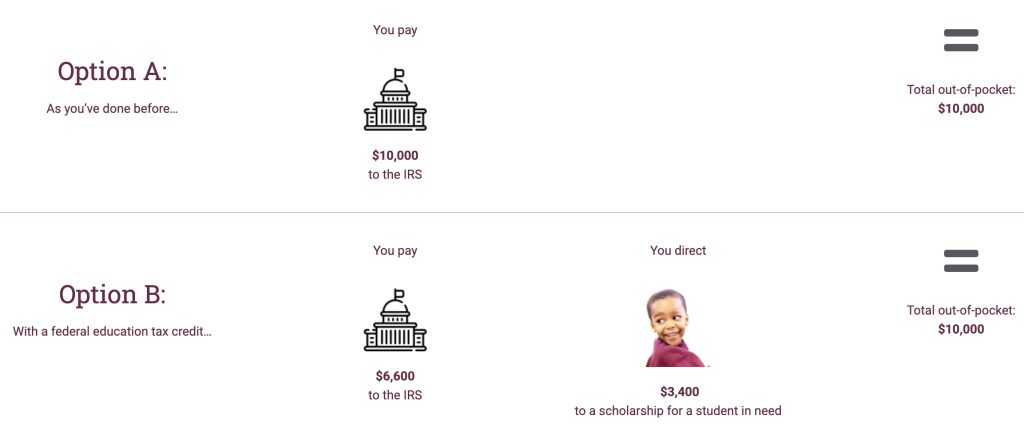
As a dollar-for-dollar tax credit, the EFTC allows taxpayers to direct money to scholarships for the schools we serve—and it won’t cost them a dime in the end. 

A couple with a $10,000 federal tax liability, for example, can direct up to $3,400 to a scholarship and pay the rest—$6,600—to the IRS. Over the last three years, the average philanthropic support needed for each of our students has been $3,500; now, a couple directing their tax credit scholarship to one of our schools could almost completely cover that gap without altering their bank balance.

Here’s what that could look like:
Ohioans might know that the program is similar to the tax credit scholarships of up to $750 for an individual ($1,500 for a couple) that the state has had for years. You can find out more about the federal program here. 

How can taxpayers participate?

It will take time for scholarship granting organizations to get contribution portals set up, but you don’t need to wait–or even follow the news. We urge you to pledge your tax credit scholarship support to students in our schools now, even before the 2027 tax filing season begins. You can do that here. Then we’ll send you everything you need to know to claim the credit when the time comes.

What new information did this week's Treasury regulations reveal?

The legislation authorizing the federal tax credit scholarships—the Educational Choice for Children Act (ECCA)—passed this summer, but the draft regulations the Treasury Department issued today provide clarity on several key points that are particularly relevant for communities:

  • Couples can claim up to $3,400. The legislation made it clear that individuals could claim up to $1,700; it’s now clear that couples can direct double that amount to scholarships.
  • Taxpayers can max out both state and federal tax credits. This was uncertain in the legislation, and it’s particularly relevant for Ohio taxpayers.
  • Scholarship Granting Organizations can serve multiple states. We knew that taxpayers from other states—particularly the 20 states that either have declined to participate or haven’t yet opted in—can direct their federal tax credit scholarship contributions to schools like ours. Multi-state SGOs might make this easier.
  • Families won’t face undue burdens proving their income to qualify. This makes the application process less onerous, particularly for low-income families.
  • While not a new rule, Treasury officials affirmed that $1,700 is NOT the scholarship amount. Scholarship Granting Organizations (SGOs) who process the tax credit scholarships can determine their own guidelines for how much scholarships are and which students are prioritized.

What do Spiderman and Catholic Social Teaching have to do with tax credit scholarships?

This Federal tax credit moves the power to direct public funds from the government to individual taxpayers and SGOs. And as we should all recall from Spider-Man, “with great power comes great responsibility.”

Those who seek to exercise the power of tax credit scholarships responsibly have two specific concerns to attend to.

Exacerbating educational inequality

Tax credit scholarships are like a well: in order for schools to draw scholarship funds out, taxpayers have to put scholarship dollars to them. What we’ve seen in Ohio should be no surprise: because wealthier communities have more taxpayers who can afford to fund a tax credit scholarship and wait to be reimbursed with their tax refund, they are more likely to contribute–and they tend to direct their contributions to schools in their communities, which often serve fewer low-income students. 

If taxpayers and SGOs prioritize low-income students, then this program can ameliorate educational injustice. But taxpayers and SGOs must consciously aim scholarship funds at those most in need for tax credit scholarships to contribute to, rather than undermine, economic and educational justice.

Using EFTC to justify cuts in other educational funding

As the Brookings Institution notes, the expansion of tax credit scholarships is coming at the same time as proposed cuts to federal programs like Title I, which provides tutoring for students in academic need in low-income communities—including those in Catholic schools. If programs specifically aimed at low-income students are cut at the same time that tax credit scholarship contributions concentrate in higher-income communities, then the educationally rich will get richer at a time when our country needs every child—including those in low-income communities—to thrive.

*This post has been updated to reflect that 2027 is the first tax year for which the credit applies.

Three Schools in Two Cities to Join the Partnership

Our Partnership community is growing!

This week, Toledo Bishop Daniel Thomas announced that two schools in the heart of the city—Rosary Cathedral and Queen of Apostles—will become Partnership Schools. Bishop Edward Malesic of Cleveland also announced that Holy Name Elementary will become that city’s fifth Partnership school.

We are thrilled for the opportunity to bring the ambition we have for children and Catholic education to these three striving communities at a crucial time. School choice policies are expanding—a crucial step toward educational equity for working-class families. At the same time, the gap between the highest- and lowest-performing American students is widening. Partnership Schools’ work places us right at this intersection of increasing opportunity and growing need.

The need for high-quality school options is particularly urgent in Toledo and Cleveland, where both cities have announced that many public schools will be closing at the end of this school year.

The Yass Prize Alumni Award is providing funding to kick-start the work of serving more students. The award inaugurates the Partnership’s National Expansion Fund, an effort to leverage local support and national philanthropy together on behalf of children in low-income communities and the Catholic elementary schools uniquely well-positioned to help them flourish—schools like Holy Name, Rosary Cathedral, and Queen of Apostles.

These three parochial schools have anchored their neighborhoods and propelled social mobility for generations. Holy Name has served Cleveland’s Slavic Village neighborhood since 1864. For most of that time, it was run by the Sisters of Charity of Cincinnati. Queen of Apostles—the oldest continuously operating school in Toledo has served the city’s Old South End since 1876, and Rosary Cathedral—has served the Old West End since 1914. A vigorous local effort, the Center City Ministry of Toledo, has kept the schools open while so many others closed. The Center City Ministry will become Partnership Schools of Toledo in the months ahead.

These are schools where generations of families have seen their values reinforced and their dreams for their children set on a path toward fulfillment. We are both humbled and exhilarated to help new families find trajectory-altering education and strong communities in all seven schools we will now serve.

Partnership Schools Named Yass Prize Alumni Award Winner

The Yass Prize has announced that Partnership Schools is the recipient of one its first Alumni Awards. The transformative award will enable the network to expand to include additional schools.

The Partnership Schools network exists to help children in low-income communities beat the odds and flourish, and this award is a powerful step forward in our effort to serve more students.

Sixteen organizations are among the Alumni Award winners, and the Yass Prize is investing over $20 million in the group. Partnership Schools is the only school turnaround organization to receive the award. 

The Yass Prize, which has been granting awards for educational innovation over the last five years, is funded by Philadelphians Janine and Jeff Yass. As the Yass Prize organization states, the award is more than an annual prize; it is “a movement to find, reward, and expand outstanding organizations across every sector and state, fostering partnerships that accelerate impact with the speed and urgency students deserve.” To date, the Yass Prize has distributed over $60 million to educational organizations—public, private, and charter schools, as well as support organizations and ed tech innovators.

Partnership Schools were recognized by the prize in 2021 before receiving this alumni award. Other Catholic Yass Prize honorees include the Cristo Rey Network and Chesterton Schools. Additional Northeast Ohio schools recognized by the Yass organization include Dreams Academy in Akron. 

The award funds provide significant momentum for the Partnership’s effort to impact more students by assuming management of additional schools in coming years, with a focus on Ohio. Kristen Gengaro, our executive director, explains, “Ohio has led the nation in offering school choice funding. Partnership Schools’ work puts us right where the expansion of school choice meets an unmet demand for high-quality educational options in working-class communities.” 

The four schools currently in the Partnership network include St. Thomas Aquinas and St. Francis in St. Clair-Superior, Archbishop Lyke in Lee-Harvard-Miles, and Metro Catholic on the near west side. 

Our Cleveland schools are a proof-point of what is possible when urban Catholic schools get the support they need to serve their communities. For example, in January of 2020, St. Thomas Aquinas announced its closure due to low enrollment before getting a second chance with the Partnership model. Enrollment has risen by over 30 percent in the last five years, and as Principal Rachael Dengler says, “We are still uniquely St. Thomas, a 125-year-old St. Clair-Superior community anchor. But we are becoming an even stronger, even more impactful version of ourselves as a Partnership school.” This year, when Cleveland public schools has announced a wave of closures similar to those Catholic schools know all too well, St. Thomas is open and ready to serve more students as an anchor in the neighborhood, thanks to past support from visionary donors.

“There is so much talent, resilience, and drive in the families and neighborhoods we serve, and we’re eager to help more children and communities flourish,” says Kristen.

The Partnership model, which began in New York in 2013, has evolved in Ohio’s unique school choice ecosystem. The network even received support from the Yass Prize last fall to share lessons learned in Ohio with Catholic schools in Texas, where public funding for parental choice is launching this fall, over twenty years after it began in Cleveland.

We are profoundly grateful to Jeff and Janine Yass and the Center for Education Reform for believing in our students, the communities we serve, and the vision we share of joyful, excellent, faith-filled schools that are an option for any family who seeks them, regardless of income.

Prayers from Our Students for the Pope—and the World

Yesterday, the Catholic Church received a new leader, Pope Leo XIV. In the period between Pope Francis’s death and the end of the conclave, those of us at the Partnership were inspired in our prayer by leaders closer to home: the eighth graders at Metro Catholic.

Led by Sr. Patti Gentile, SND, the Metro eighth graders crafted intercessory prayers inspired by the life of Pope Francis. Even as we welcome Pope Leo, we invite you to join our own students in prayer inspired by his predecessor.

  • Pope Francis, you weren’t worried about who someone was; all you did was love. By your example, help us to move past our thoughts and love someone who seems unloveable.
  • Pope Francis, you always wanted to be equal with others around you and help those in need. By your example, help us to be equal with our peers and to help those in need.
  • Pope Francis, you were someone who didn’t let your role as a pope make you someone who was unapproachable. By your example, you taught us that no matter who we make out to be, we can maintain a simple life and dedicate ourselves to help those who cannot help themselves.
  • Pope Francis, you kissed prisoners’ feet and encouraged a girl with a skin disease to be  brave and sing to help her deal with bullies. By your example and your care and love, you help us to be better.
  • Pope Francis, you were humble and tried to relate to the average person, never indulging in too much luxury. By your example, we can learn to help and never get too complacent for what we have and who we are.
  • Pope Francis, you were known as the People’s Pope. By your example, help us to care for other people and not just ourselves.
  • Pope Francis, you thought of yourself as a regular human and knew not to judge. By your example, help us to say, as you did,  “Who am I to judge?”
  • Pope Francis, you always had a great sense of humor. By your example, please help us to know it’s okay to not always be serious and make situations lighter.

Aleena Grant, an eighth grader at Metro Catholic, also reflected on her hopes for the new pope—even before the conclave began. We hope her aspirations for moral leadership in the world inspire you and give you hope in our young people.

If I could write to the new pope, I would say…

Lead by actions, not just by words. The world needs to build trust with you, and a great way to do that is not by telling people what to do, but by showing it.

Bring attention to political problems like war, killings, mass displacement, and governments being taken over by extremist groups, so that there can be prayers coming from all over for peace.

Work on bringing the entire Body of Christ together more, whether Catholic or not. The disciples in the Bible show us that being a believer is easier together, rather than alone.

Finally, remind believers to remain faithful, even in uncertain times. For the past few years, uncertainty has spread all around the world, whether it be about political issues or something more personal like money problems. Remind us not to fear, and to keep placing our trust in the Lord.

Amen!

One Partnership Student’s Path to The Best High School in Cleveland

If you ask Partnership principals and network staff what the best high school in Cleveland is, you should get the same answer from each of us: It’s the school where each individual student best fits and can flourish fully. Luckily for our students, there are a wealth of “best” high schools in Cleveland. We’ve shared stories of students headed to some of those schools here, here, and here, for example. But when we saw how Zion Pinnock reacts when he speaks about the high school he’s headed to in the fall, we got more than another great example of what a fit-flourish high school placement looks like; we got a share in his excitement.

Currently an eighth grader at Archbishop Lyke, Zion is headed to the Hawken School, an independent day and boarding school. “They are really into engineering, and I love that there are no grades,” he beams. The Mastery School—Hawken’s newer campus in University Circle, where Zion will attend—uses a mastery approach, where students’ transcripts reflect skills and content they have mastered instead of traditional grades.

Other features of the school have him really excited: “They have two-week intensives where you are focused on one subject before a break, and that’s a great way to learn something. And I plan on joining the philosophy club, the photography club—I want to try a lot of new things.”

His grin gets even wider as he explains, “My mom is super-proud. She knows it’s a really good school, and she’s proud of me being able to get in.”

Zion relied on a number of partners to help with his path to Hawken. He’s an enthusiastic participant in after-school and summer enrichment programs run by Boys Hope, Girls Hope (soon to be re-christened Hope Ignites), and it was a private school fair sponsored by that organization where he first encountered Hawken. He met with the admissions office multiple times, and he got help on his application from a knowledgeable resource close to home: his older brother, who goes to the Cleveland School of Science and Medicine and wants to be a doctor. His brother also sparked his interest in robotics. “We used to build robotic kits together—including a robotic hand.” 

Zion also credits Archbishop Lyke—where he has attended since Kindergarten—with preparing him well for Hawken. He explains, “The curriculum here is harder–for example, we take Algebra 1–which a lot of people don’t take.” And he also feels that the friendliness of the teachers at Archbishop Lyke is similar to that he’s seen so far on visits to Hawken.

We are proud that most of our students go on to attend Catholic high schools. Yet as we work to increase opportunities for all our students to be ready to flourish in high school and beyond, we’re grateful that there are so many “best” high schools in Cleveland where Zion—and dozens of other students—can find the learning experiences they need to fulfill their family’s aspirations and find joy along the way. 

Cutting the Federal Department of Education and Catholic Schools: What We Know So Far

As a nonprofit Catholic school management organization, we do not know yet what impact the executive order eliminating the federal Department of Education will have on the students in our schools or the communities we serve.

Here’s what we do know so far: 

1. Many Catholic schools—including ours—benefit from federal funding currently administered through the Department of Education. We hope that changes in the systems and staff who administer those funds will not negatively impact the tutoring and other services our students and schools receive, this year worth around $800,000 for our four schools (not including the federally subsidized breakfast and lunch each of our students eats every day, a program run through the Department of Agriculture). 

2. A healthy school choice ecosystem benefits from great public schools. The Partnership advocates for Catholic schools; we believe in their unique power, and we work to ensure that all families who want an excellent Catholic education have access to it. But school choice is not a zero-sum game—indeed, it relies on families having multiple strong choices. 

We’ve seen first-hand how Catholic schools can benefit when there is a high-performing public or public charter school nearby.  The competition can create positive pressure for a Catholic school to get even better academically—and children at both schools benefit. 

Additionally, when families have good school options, then they choose Catholic schools not just because they are an alternative, but because they are a Catholic alternative—and the culture of faith and values in our schools gets a boost. 

3. If eliminating the federal Department of Education causes services to diminish in public schools in poor neighborhoods like those we serve, there is a chance more families will seek out Catholic schools if they remain open nearby. Yet we and other Catholic schools must then step up to serve an even greater variety of needs than we already do—and will need to rely on our supporters, our teams, and our faith as we do.

4. As people of God, we want all children to flourish—not just those we serve. Indeed, we believe our salvation depends on what we do “to the least of My brethren,” as Jesus says in Matthew 25:40. The programs of the federal Department of Education have been particularly aimed at filling gaps in state and local services to students with precisely the kinds of needs Christ calls us to look out for. The department may be changing; the moral imperative to meet the needs of those it serves cannot change.

With lots of attention aimed at what is ending and being taken apart in our country, we pray for renewed attention to what we can build together—including an educational ecosystem where families have multiple great choices, and where we as voters, donors, and educators dedicate ourselves to making equality of opportunity a reality in the lives of all students, children who, Catholics believe, are made in God’s image—whether they attend Catholic schools or not.

NAEP Results: A Call to Action for Catholic Schools

Student achievement across the country remains below pre-pandemic levels in all grades and subjects, according to results released this winter for the 2024 National Assessment of Educational Progress (NAEP)—often known as “The Nation’s Report Card”. The results should  concern all of us: for example, a third of U.S. 8th graders cannot read at even a basic level, according to the test.

The data that should energize every American with a sense of urgency around K12 education. Yet the Partnership team is galvanized by analysis of several subgroups’ results—even though our students are not among the national sample of students who took the NAEP. 

First, the data confirms that the Partnership’s efforts are aimed right where they are sorely needed. “Cleveland students are performing far worse than students across the nation, in Ohio, and in the majority of urban districts,” notes the Fordham Institute’s Jessica Pointer. Her breakdown of the city’s scores can be found here. 

Propelling academic achievement in Cleveland is challenging; Partnership educators will be the first to agree. But we also believe what we tell our students: We can do hard things. We know from our own classrooms’ results that progress is possible. 

Second, analysts like Chris Stewart are affirming who must be the focus of improvement efforts, and how those efforts must take shape. American student achievement is not declining across the board; rather, declines are accelerating among the bottom half of test takers, a group that is disproportionately composed of low-income students. 

“We are witnessing not just an educational decline but a sorting of America’s children into educational haves and have-nots,” Stewart explains. 

He goes on to assert that while the solutions must come from “engaging families, communities, and society” broadly, “schools are the biggest investment we make into teaching, learning, and outcomes.” And he asserts rigorous, long-term use of evidence-based instructional practices in schools—like those we are using and refining in Partnership classrooms—are key to reversing a trend that impacts our entire nation, not just students who struggle.  

Finally, the NAEP results affirm the unique power of Catholic schools—and caution us to be intentional about preserving and amplifying that power. A team from Boston College notes that yet again, Catholic school students outperformed their peers in public schools. 

The Partnership team’s own analysis confirms that the Catholic school advantage holds true as well for subgroups at the heart of our work, including Black and Hispanic students. Black students in Catholic schools outperform their peers in both public and public charter schools, in both reading and math. Hispanic students outperform their peers in all tests and both sectors by even wider margins. 

Yet within Catholic school students’ NAEP scores, the gap between Black and Hispanic students’ performance and their White peer’s widened more among Catholic school test takers than across the nation as a whole between 2022 and 2024. Thus, the Boston College NAEP analysis demonstrates the need to work proactively and intentionally to ensure that our schools’ outcomes are as equitable as the ideals of our faith.

The ability of Catholic schools to drive meaningful outcomes for children from historically disadvantaged communities matters beyond our own communities, for the school choice movement as a whole. Critics of school choice insist that there aren’t enough quality seats in low-income communities to deliver on the promise of school choice to those who need it the most. The Partnership team is committed to proving otherwise. Every day, as our team works together with teachers and principals to deepen learning in every classroom, we are determined to prove what can happen when Catholic schools in striving communities get the support they need—at a time when NAEP scores suggest it matters perhaps more than ever.

Five Lessons from 125 Years of Cleveland’s St. Thomas Aquinas School

This year, St. Thomas Aquinas School on Cleveland’s near east side celebrates its 125th anniversary. The vintage building contains classic elements that many Catholic school grads across the country would recognize: high ceilings, the scents of wood and floor polish, hard-working teachers and parents whose firm, warm instructions bounce off the tiled walls. Yet for all the timeless feel, the school’s history is dynamic—and it has powerful lessons to teach those of us who are fans of Cleveland, of urban communities, of Catholic schools, or of all three.

1. Catholic schools’ power to strengthen communities propelled their heyday.

St. Thomas Aquinas parish became the “Irish Cathedral” of Cleveland and helped accelerate the growth of the neighborhood around it. By 1950, it served over 2,000 families, and it spawned the founding of other parishes to meet the growing need. As Notre Dame’s Prof. John McGreevy notes in his study of the Catholic parishes’ impact on the development of American cities—Parish Boundaries: The Catholic Encounter with Race in the Twentieth-Century Urban North—Catholic congregations built more than churches; they erected schools and housing for religious orders to staff them, which “anchored Catholics to particular neighborhoods” in ways that other denominations did not.

Educational and social offerings as well as religious services ensured that immigrant families and their descendants had a place where they belonged in a new country not always welcoming to newcomers, particularly Catholic ones. Catholic schools in our own day can tap into this historic power by fostering belonging along with knowledge, skills, and faith. Current St. Thomas Principal Rachael Dengler, parents, and the school’s staff are doing just that: offering an expanding number of community activities, like their dad’s group.

In a culture that can be both individualistic and lonely, Catholic schools that act on our beliefs that we are made for each other—that are lives are fullest in community—can offer what few other types of schools can.

2. Catholic institutions played an often-overlooked role in the histories of cities and of striving African-American families.  

By the late 1940s, St. Thomas parishioners included not only European-American immigrants and their descendents but African-American families who were part of the Great Migration. The school integrated years before Brown v. Board made segregation unconstitutional, and prominent Black Clevelanders—like insurance company founder M.C. Clarke—joined the parish.

Yet a student can be enrolled without being truly welcomed. As Sr. Dorothy Ann Blatnica, VSC, notes in At the Altar of Their God: African American Catholics in Cleveland, 1922-1961, “The struggle of African American Catholics to become a vital part of the American Catholic Church is as old as the story of slavery in America itself.”  Her history of the city’s Black Catholics includes the challenges of families moving into St. Thomas Aquinas to be fully accepted in the school and parish community. M.C. Clarke, for example, was denied entry into the Knights of Columbus. Yet according to former associate pastor Fr. Edward Camille, St. Thomas’s Black families soon “assumed leadership in the parish and became involved in all aspects of parish organization. These same individuals support and foster each other’s personal lives as well.”

Fr. Camille also notes that even as racially driven fights among teenagers broke out in nearby Rockefeller Park, “the parish school became one of the most effective means for the children to become acquainted with those of other races.”

The ideals of our faith can equip Catholic schools to become instruments of building the beloved community, even as we grapple with the same social pressures that all schools experience.

3. American communities are constantly shifting—and our schools must shift too.

In Surrogate Suburbs: Black Upward Mobility and Neighborhood Change in Cleveland, 1900-1980, Georgia Tech Professor Todd Michney traces Black Clevelanders’ migrations up from the south, into zones of Cleveland artificially restricted by racist housing practices, and then out in stages to suburbs. Along the way, he recounts, Black families participated in a vibrant array of civic groups—from informal block clubs to more formal neighborhood associations—and leveraged the power of community relationships to solve problems and advance each others’ interests.

Yet while many longtime St. Thomas parishioners saw new neighbors as fellow churchgoers pursuing the same goals, others saw threats. Indeed, the parish saw a concentrated wave of “blockbusting”—the insidious real estate practice of spreading rumors of growing disorder and impending home sales nearby to get home owners of both races to sell fast and cheap, and then turning around to rent properties at an inflated rate to Black newcomers with limited options due to discriminatory housing practices. In fact, blockbusting in the St. Thomas parish community was so pronounced that Prof McGreevy uses it to exemplify the practice in Parish Boundaries.

St. Thomas pastor Fr. John A Clark, appointed in 1958, fought the practice hard—visiting thousands of living rooms to persuade parishioners to stay. Bishop Floyd Begin encouraged him and others, asserting that “It’s good Catholicism, good Americanism, and just good common sense to work together as good neighbors to make your community and city the best in the world.” But families of both races moved out, and from a high of 2,000 families in 1950, St. Thomas declined so rapidly that by 1975, the church was condemned, demolished, and not rebuilt.

It is intriguing to consider what the American urban landscape would look like today if efforts like Fr. Clark’s and and a core of St. Thomas families had succeeded in maintaining robust, economically and racially diverse parishes in the heart of cities across the country. As we celebrate the powerful community-building of parishes like St. Thomas in their early decades, we must also look to the vacant lot next to the school—where the church once stood—and hear a call coming from its past to build communities a little differently moving forward.

4. Resilience—and redemption—comes from broadening our communities.

Yet St. Thomas Aquinas School has outlasted even the parish that created it. That has happened in large part because St. Thomas persisted in doing what few other neighborhood institutions can: offering a sense of community, anchored in values and shared aspirations, just as it did in a bygone era. Jeff Allen, a dad active in the school’s dads’ group, comments that the school is “becoming a community center”—just as it was founded to be 125 years ago.

That community is welcoming of children of other denominations, and it is not alone. In 1970, just three percent of students in American Catholic schools were not Catholic; now, over twenty percent are non-Catholic. The universal Church has broadly appealing institutions right in neighborhoods that could use them the most, and a wide array of families are seeking them out.

The founder of Partnership Schools in Cleveland, Rich Clark, also brought to the school a wider community of supporters who want to see the neighborhood and the city’s tradition of working-class Catholic schools continue to thrive. And the network is expanding and strengthening ties with more of Cleveland’s exceptional high schools. This expansion of St. Thomas’s community provides what sociologists call both bonding and bridging social capital. Striving to be as energetically welcoming as we are unapologetically Catholic also helps us heed our Gospel call.

5. Public funding for school choice is essential—and insufficient.

In 2020—more than two decades after Cleveland and EdChoice Scholarships put Cleveland in the vanguard of the school choice movement—the announcement went out that St. Thomas Aquinas School was closing, only to be reversed just weeks later when the Diocese announced that the school would stay open and become a Partnership School. The school’s near-closure is a cautionary tale for the growing number of places across the country where parents are now able to access public funding for school choice.

Vouchers, tax credit scholarships, and education savings accounts all offer new possibilities for parents—and Catholic schools. But over thirty percent of Cleveland’s Catholic schools closed after scholarships became available. In part, that’s because the initial funding was insufficient—and still falls far below that of charter and public schools.

Yet schools also need more than state funding to serve students well. In addition to philanthropic investment, new forms of support are vital, particularly to serve students coming to us from other sectors, who may have learning gaps or school culture shifts to navigate. By finding creative ways to provide comprehensive supports like teacher coaching, curriculum guidance, and leadership development to schools like St. Thomas, we can answer one of the critiques of universal school choice: that it benefits the poor less than others. In the process, we can reinvigorate urban Catholic schools, the largest potential source of school choice seats in many low-income communities.

The Good of the Other

St. Thomas Aquinas–the school’s patron saint–defines love as “desiring the good of the other.” In the final analysis, it is love that has helped St. Thomas persevere. Generation after generation of community members have willed the good of other people’s children at the corner of Superior Avenue and East 91st Street. Jeff Allen, St. Thomas dad and volunteer, has said about the students: “They aren’t my kids—but they are all my kids.” If enough of us see the children of St. Clair-Superior and neighborhoods like it the same way Jeff does, then schools like St. Thomas can thrive well into their next century and more.

“At St. Francis, I feel like I can be myself”—A Mother and Daughter Reflect

We often say that Partnership Schools are more than classrooms; they are communities. Recently, one mother-daughter duo—mom Je’Nice and sixth grader Je’Shauna—shared what the St. Francis School community means to them. 

In a few powerful words, they explained:

Je'Nice–Mom and Volunteer Cheerleading Coach

My child excels here. She brightened up when she came back to St. Francis. 

I like it for the structure; children need structure. They pray. They learn how to be respect­able. Some places are institutionalized, but St. Francis is warm, because they get to know the children individually.

There is an open door. The teachers and principal welcome parent involvement. Ms. Hanna (who became principal this year) really brought warmth to the school. The communication we need is there.

I have high expectations, and  the school supports them. I want to make sure my daughter graduates from high school, and want her to have the choice to go to college. I want her to be able to afford things, and also to be humble—a giver who shares, cares, and doesn’t look down on others. 

It is worth driving my daughter here!

Je'Shauna–Sixth Grader

This is the best school. 

We are cherished. We learn hard things. There is a higher standard of learning here, and I like it being more challenging. Right now in math, we are factoring. Today, it got easy.

We make people feel welcome. If there is a problem, the adults take care of it. I am happy when I come to school. It’s mostly fun. 

At St. Francis, I feel like I can be myself. 

Alumni in College Explain the Impact of Their Partnership Schools

In November, three alumni of schools managed by the Partnership in New York from 2013-2024 joined the organization’s Board of Trustees meeting to discuss the foundation they received in Partnership-run elementary schools. Their experiences speak with unique power to the impact that urban Catholic schools can have when they get the support they need. 

Antoine Peralta-Castro

Our Lady Queen of Angels, 2018

Cristo Rey-New York High School, 2022

Fordham University, 2026

With his brother in high school.

A lot of kids at the public elementary school I attended were not advancing academically, and a teacher advised my mother and father to send me to Catholic school. At Our Lady Queen of Angels, a Partnership School, the teachers cared about me, and I was always learning—surpassing my limitations. It didn’t just benefit me; my three younger brothers went too. My brothers are achieving way more than I have.

I went to Cristo Rey New York, and now I am attending Fordham University, studying computer science. I don’t think I would have gone to college if I had stayed on the path I was on, considering where I was going to school.

One step into a great education can lead to multiple doors opening.

Arlenys Ceballos

St. Athanasius, 2017

Cristo Rey-New York High School, 2021

John Jay College, 2025

In her St. Athanasius uniform.

My parents made a lot of sacrifices when they immigrated to the United States. One of those sacrifices was making sure that I had a quality education. When they could have paid for a car or a new house instead, they paid for me to go to school. It would be one thing if they sent me to a school where, you know, teachers were just there for the paycheck. But at my Partnership school, St. Athanasius, the teachers genuinely had heart and soul, and they would take time out of their days just to make sure I was OK. I struggled in classes in English, but the teachers would try their best to make me understand things and support me academically.

I would not be where I am today or have the resume that I have without that foundation. I am studying at John Jay and working at a law firm where I am able to find a community of people who truly care for me and want to see me succeed, and I want to see them succeed. 

It is a great fortune that I have—that the Partnership was able to come and bless my life in an unexpected way, when I was eight years old and didn’t want to do my math homework. I am grateful for the experiences there that have led me to be the woman I am today.

Josue Ramos Carpio

Our Lady Queen of Angels, 2017

Xavier High School, 2021

City University, 2025

Dan Denihan Josue meeting 2017 cropped
In eighth grade, shorty after he was accepted to Xavier.

Partnership Schools have impacted my life and my family’s life. I was in the public school system before, and it was OK, but I felt lost. At Our Lady Queen of Angels, I felt like I really had a place to be. Now, I am studying political science in the honors program at City College, and I am a Colin Powell Fellow in Leadership and Public Service. 

My middle school teacher sparked my love for history and political science. I remember him pushing me to read the hardest books, and then read a little more. Now I am thankful for it as I’m studying cases that are 200 pages long, and I remember him.

He and my principal pushed me toward the right choice for high school, which was Xavier. My brothers have gone to Xavier too, which shows just how transformative OLQA was.

My principal at OLQA pushed me to get involved on campus, and now I work in student government and am vice-president of the pre-law society. I interned at Freed Frank this summer, and after law school I would like to be in a corporate law firm that challenges me every day to think outside the box and learn more about business and the world. I also want to give back to my community; that’s the biggest goal.